
Numpy and Pandas: The Native Language of Quant Developers
01 - This Is Your Quant Native Language
Just as death and taxes are inevitable, Numpy and Pandas hold an equally indispensable position for quantitative professionals. Every quant will inevitably interact with these two libraries.
If you examine critical quantitative libraries such as alphalens, empyrical, backtrader, tushare, akshare, jqdatasdk, or excellent quantitative frameworks like quantaxis, zillionare, and vnpy, you will find they all rely on Numpy and Pandas. In fact, any library that depends on Pandas will inevitably have a transitive dependency on Numpy.
If quantitative professionals share a common language, it is Numpy and Pandas. They are the native language of quants.
Specifically, Numpy and Pandas provide data structures akin to tables—Numpy structured arrays and Pandas DataFrames—which are essential for intermediate storage of various data types, including market data. They also offer numerous fundamental algorithms.
For example:
- In pair trading, calculating correlation is a crucial step. Both Numpy and Pandas provide functions for correlation calculations.
- In Alpha 101 factor computation, ranking is a foundational operation—the basis for layered backtest. Pandas provides this functionality via the
rankmethod. - Max drawdown is a key metric for evaluating strategies. Numpy supports this through
numpy.maximum.accumulate.
There are many such commonly used algorithms, which we will introduce one by one in this course.
Course Structure
A distinctive feature of this course is its tight integration with quantitative scenarios. We analyze the source code of important, high-popularity quantitative libraries to identify where Numpy and Pandas are used, then categorize and refine these usages. We also incorporate frequently asked questions from the quantitative community—often representing the difficulties quants face when using Numpy/Pandas—to structure the curriculum. This ensures a systematic explanation of these critical libraries while guaranteeing that learners can immediately apply the methods and techniques to their work, rapidly boosting productivity.
Efficient learning requires high-intensity practice. This course includes extensive exercises. Both demonstration code and exercises are designed within quantitative scenarios to enhance your immersion. However, this often requires you to understand these scenarios and the underlying data.
While developing this course, the author read numerous books, blog posts, papers, and open-source project codes. For content closely related to the curriculum, reference links are provided as extended reading or footnotes. If you have time, you may read these to gain the same perspective as the author. However, if you are short on time, you can skip these sections and focus solely on the main course content.
This course is specifically designed for quantitative trading practitioners, such as quant developers, quant researchers, and quant portfolio managers. If you have basic financial knowledge, this course is also suitable for others needing to learn Numpy and Pandas. The breadth and depth of the content are rare in the current market.
What Is Numpy

Image Source: numpy.org
Numpy is the foundational package for scientific computing in Python. It is open-source software that allows free use while preserving original copyright notices. Its name derives from Numeric Programming, and its predecessors were the Numeric and Numarray libraries.
Numpy provides multidimensional array objects, various derived objects (such as masked arrays), and high-performance routines for array operations, including mathematical, logical, shape manipulation, sorting, selection, I/O, discrete Fourier transforms, basic linear algebra, basic statistical operations, and random simulations. The following image provides a more detailed overview:
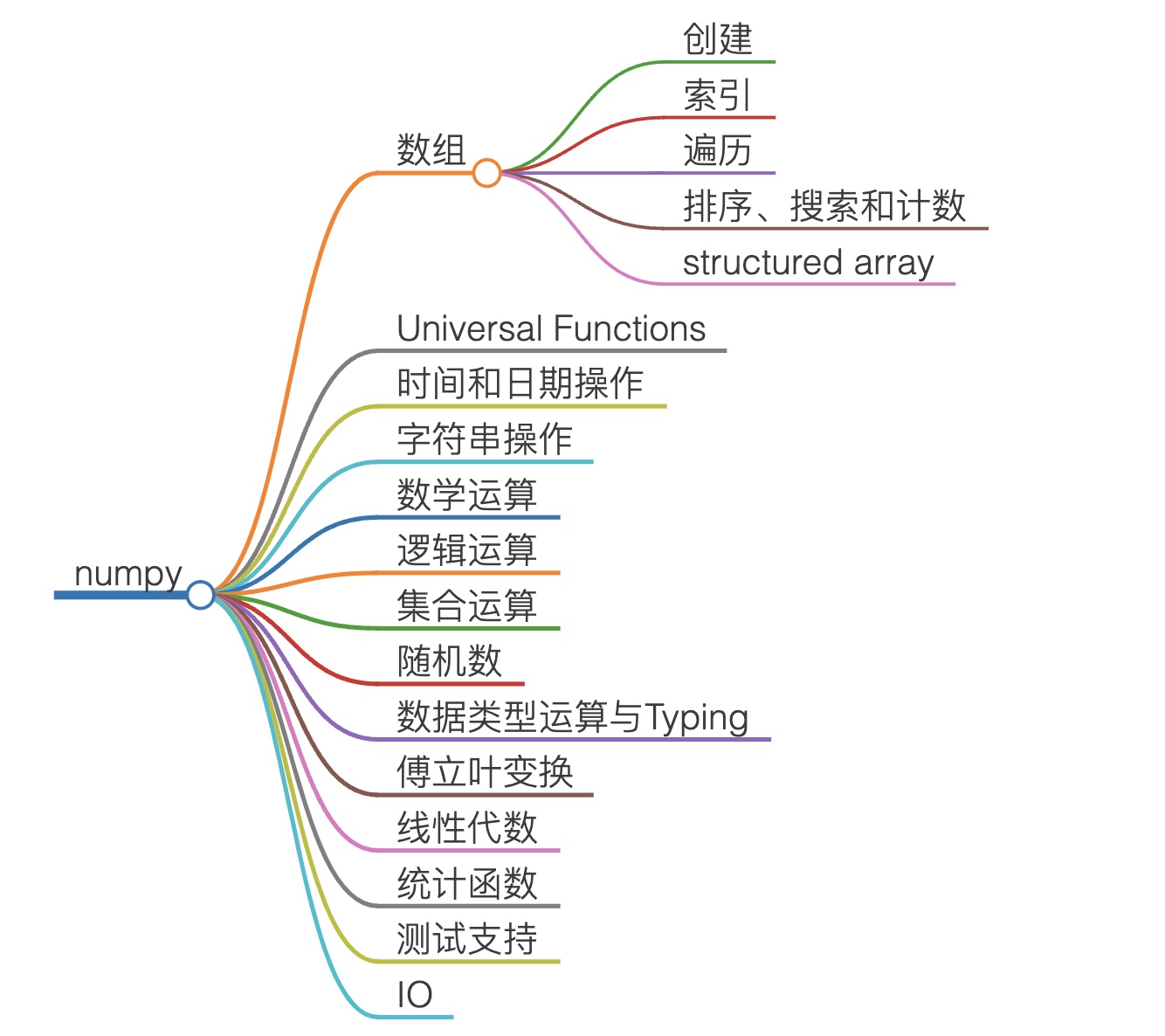
Numpy’s underlying development language is C, with significant optimizations, including parallelization support, use of OpenBLAS, and advanced SIMD instructions to optimize matrix operations. Python’s flexibility as a "glue language" enabled Numpy to be released as a Python library.
tip
Many believe that to improve quantitative strategy performance, one must abandon Python for C/Rust. This statement is both right and wrong.If a quant does not understand how to leverage OpenBLAS and LAPACK, even algorithms developed in C may not outperform those calling Numpy via Python. In Numpy, a common matrix multiplication can utilize multi-core parallel processing (multi-threading) and advanced CPU instructions to achieve fast BLAS/LAPACK operations. These knowledge and techniques are difficult for most people to master.
You can check if your Numpy utilizes OpenBLAS/LAPACK and advanced SIMD instructions using the following method:
```python import numpy as np np.show_config() ```
Numpy is also the underlying dependency for many well-known Python libraries, including Pandas, SciPy, Statsmodels, and Scikit-learn.
What Is Pandas
Pandas is a Python software library for data manipulation and analysis. It is built on top of Numpy, adding features such as indexing and heterogeneous arrays (equivalent to Numpy’s Structure Array—a concept we will explain in detail later in this course), making it a powerful tool for handling tabular data.
Pandas’ name comes from the terms Panel Data (a term in econometrics referring to datasets observing the same individuals over multiple periods) and Python Data Analysis.
Since becoming an open-source project in 2010, Pandas has grown into a substantial library, with a developer community exceeding 2,500 distinct contributors.
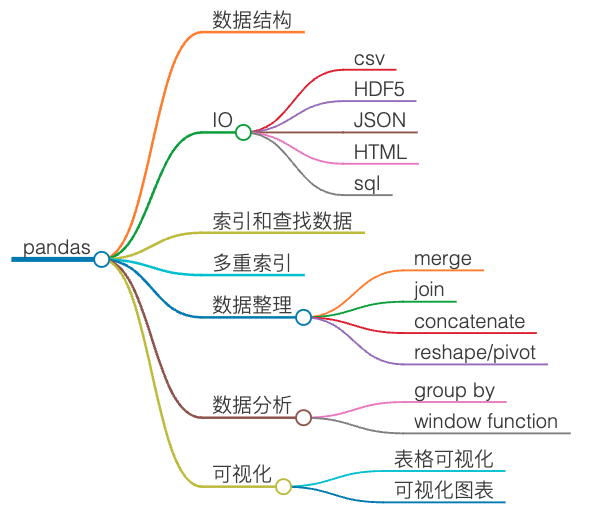
Pandas provides two data structures: Series and DataFrame. It previously offered a three-dimensional structure called Panel, but ultimately abandoned it. Compared to Excel, Pandas can analyze larger datasets more quickly (typically under 10 million rows, depending on the machine’s physical memory).
Extended Reading
 Source: Github README project
If one book on Pandas must be recommended, undoubtedly, no book is more authoritative than Python for Data Analysis. This is because it was written by Wes McKinney, the creator of Pandas! The book is now available for open access online. Readers can also click this link to read it. Updated in April 2023, it now supports up to Pandas version 2.0.
Wes McKinney is the creator and lifelong Benevolent Dictator for Life (BDFL) of Pandas. He currently resides in Nashville, Tennessee, and is the CEO and co-founder of DataPad.
Wes McKinney graduated from MIT with a bachelor’s degree and holds a Ph.D. in Mathematics and Statistics from Duke University. While working at AQR Capital Management, he learned Python and began building Pandas. He is also a co-creator of Apache Arrow.
From the history of Pandas’ birth, it is undeniable that Pandas was born for finance/quantitative finance. Wes McKinney’s original intention was to solve the inefficiency and繁琐 (tediousness) of using Microsoft Excel for financial data analysis and statistical operations. Today, quantitative giant Two Sigma[^two-sigma] is a major sponsor of this project. Pandas’ success has also promoted the widespread popularity of Python. One could even say that McKinney single-handedly carved out Python’s survival space.
Creating Pandas generated no direct revenue. Wes McKinney initially relied on savings from his first job and part-time work to make a living. This is a story reminiscent of The Moon and Sixpence, with the protagonist’s background being extremely similar—he was also a financial worker. Fortunately, Wes McKinney achieved success. If you are interested in this story, you can read the article Sustainable Open Source Projects Will Win the Future.