
Santa Claus Rally: History, Causes and Exceptions
Posting every day. Around 1,000 words, with charts and illustrations.
Note: we didn't miss a day on this one.
The Santa Claus Rally describes the tendency for stocks to keep rising around Christmas on December 25. The term was coined in 1972 by Yale Hirsch, founder of the Stock Trader's Almanac, who defined it as the last five trading days of the year plus the first two trading days of the new year.
According to CFRA Research, since 1945 the S&P 500 has posted a positive return on average across the last five trading days of the year and the first two of the new year, rising in 79.2% of those seven-day windows. Data compiled by the Stock Trader's Almanac from 1950 to 2022 shows the Santa Claus Rally occurred 58 times — in about 80% of all years.
Why the Rally Happens
J.P. Morgan attributes it to holiday optimism, investment of holiday bonuses, year-end tax considerations, and end-of-year holiday shopping, among other factors. Some theories echo J.P. Morgan's view, while another holds that institutional investors are on vacation at this time of year, leaving the market to retail investors who tend to be more bullish.
It's worth adding some context on consumer spending. The Friday after Thanksgiving (around November 24) is known abroad as Black Friday, kicking off a stretch of strong consumer demand that can lift corporate earnings — especially in retail — and push up share prices. Since the market takes time to digest information and shocks tend to propagate over multiple periods (i.e., factors at t-2 still influence outcomes at t), this boost will most likely persist through Christmas.
Psychology likely plays a role as well. Yale Hirsch often quoted the line, "If Santa Claus should fail to call, bears may come to Broad and Wall" — meaning that if the Santa Claus Rally fails to show up, the year ahead may disappoint. As a result, even a hint of optimism can amplify the rally, while pessimism can make it worse.
Santa Claus Rally in Historical Data
When Does the Santa Claus Rally Start?
The exact start date is actually disputed. Most investors think the uptrend begins in the week before Christmas, while others define the window as starting at Christmas and running through January 2. Despite the disagreement over timing, the persistent advance itself is undisputed.
What Happens in December
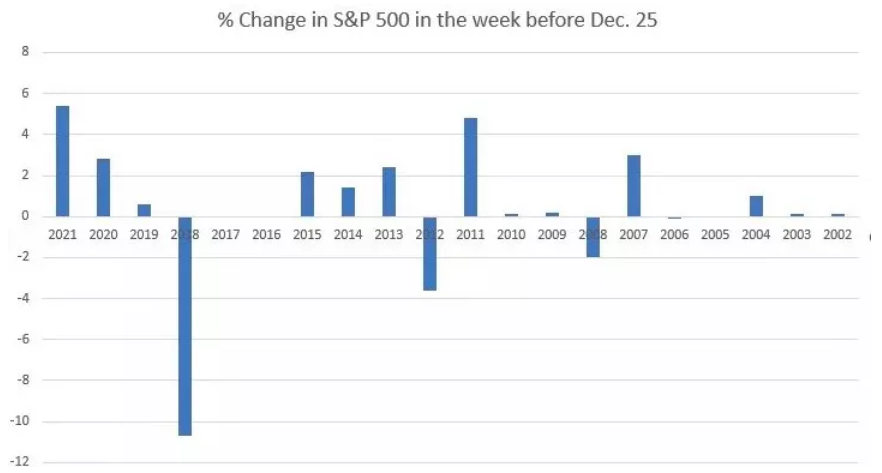
Looking at the S&P 500's performance in the week before December 25 from 2002 to 2022, there is little evidence of a Santa Claus Rally. As the chart below shows, returns were positive in 13 years, negative in 5 years, and flat in 2 years. Although many investors attribute any strength in the weeks before Christmas to the Santa Claus Rally, December alone does not warrant excessive optimism — history includes plenty of negative years.
What Happens in January
By Yale Hirsch's definition, the first two trading days of January are part of the Santa Claus Rally. Investors may buy in anticipation of higher prices in January, reflecting upbeat sentiment — a pattern also known as the January Effect.
When the S&P Breaks the Pattern
Although history seems to support the Santa Claus Rally and its power as a signal for the year ahead, past performance is no guarantee of future returns — and not every year follows the script.
For example, the end of 2015 delivered a negative return, yet the S&P 500 gained 12% in 2016. Conversely, despite a Santa Claus Rally at the end of 2021, the S&P 500 finished 2022 in negative territory — its worst return in recent years.
So while it's worth watching for a year-end rally, remember it involves an element of randomness. It isn't like the Leonid meteor shower that reliably appears every November. The only guaranteed arrival is Santa Claus himself — and only if you've been good.
Merry Christmas And Happy New Year!
China A-shares have a similar seasonal pattern, generally called the Spring Festival rally. Statistics put its occurrence at over 80%, but its timing varies. It can start in mid-December or sometime in January; it can end before the Lunar New Year or run all the way into the Two Sessions.