Be Guided by Beauty: Remembering Jim Simons
On Saturday morning I woke up to the news of James Simons's passing everywhere. Most people knew him for his wealth and his quant hedge fund firm — Renaissance. But the identities most worth remembering are mathematician and philanthropist.
Simons was born in Massachusetts in 1938, graduated from MIT, and earned his PhD at UC Berkeley. He held positions at MIT and Harvard, then chaired the mathematics department at SBU (Stony Brook University). He later crossed over into finance and built the legendary Renaissance hedge fund.
As a mathematician, his greatest achievement was the Chern-Simons Theory he proposed jointly with Shiing-Shen Chern, which has been widely applied in low-dimensional topology, quantum field theory, and string theory.
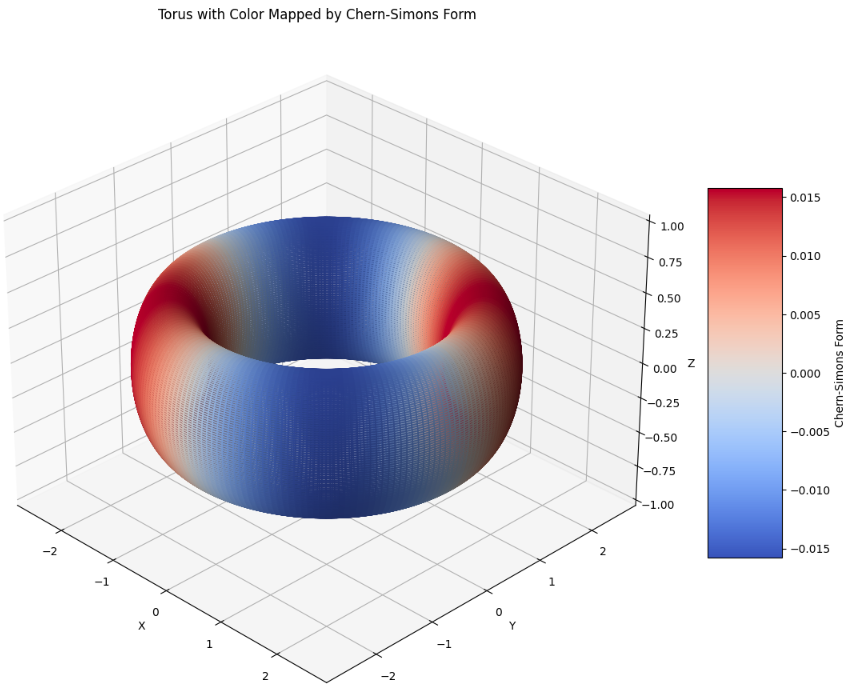
The image below is said to show the Chern-Simons Form under fluid impact, plotted against 3D surface position and polar coordinates (drawn from code shared by 鹿鹿数模 on Zhihu). I am sharing it here simply because it is beautiful — following Simons's guiding principle: "be guided by beauty."
tip
Be guided by beauty. At the AMS (American Mathematical Society) Einstein Lecture held at MIT in 2014, Simons was invited to give a talk titled *Mathematics, Common Sense, and Good Luck: My Life and Careers*. In it, he shared these guiding principles:Always do something new;
Be guided by beauty;
Don't give up easily.
He then joined Stony Brook as chair of the mathematics department. The most important task in that job was arguably poaching talent. Perhaps thanks to his earlier business experience, he thrived at it, bringing in so many people that Cornell, in the same state, protested to the governor. Through his efforts, Stony Brook's math department grew from obscurity to more than 20 mathematicians, becoming one of the world's top centers for geometry. That also laid the talent foundation for his later success in founding Renaissance.
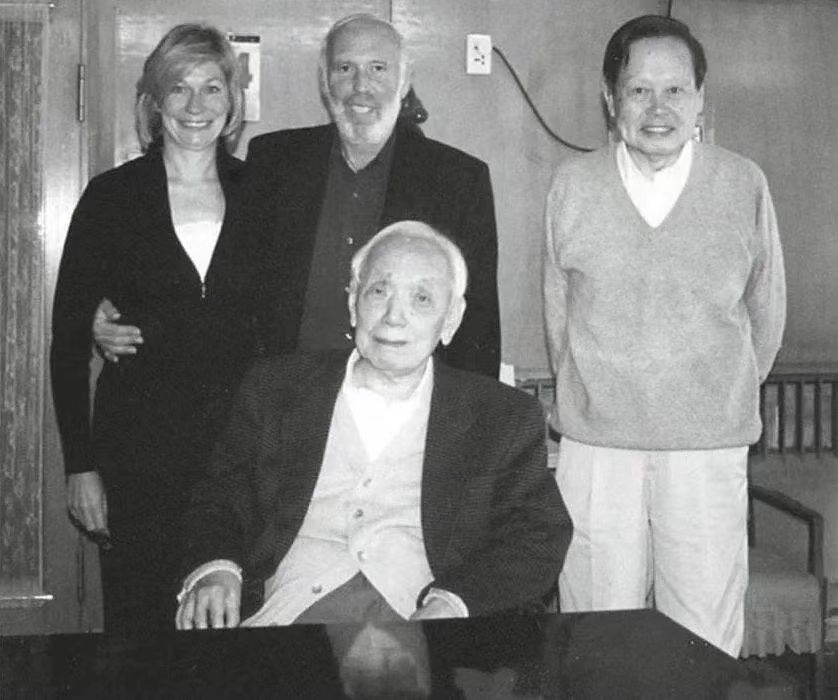
Even a great talent scout misses sometimes. His biggest miss at Stony Brook was failing to discover Shing-Tung Yau, then a teaching assistant — the mathematical giant who recently came under attack from "experts" like Xiang Ligang after a speech at Huazhong University of Science and Technology. Still, Simons always had a special affinity with Chinese scientists. Below is a photo of him with Chen-Ning Yang and Shiing-Shen Chern:
To ordinary mortals Simons looked like a born genius, but even he ran into problems he could not solve. When trying to prove the conjecture that certain geometrically defined numbers — such as $pi$ — are irrational in almost all cases, he hit a setback that left him discouraged, even a little despairing, and ultimately pushed him toward finance.
In 1978, Simons founded an investment firm and began trading full-time.
His departure drew different reactions. His father said giving up tenure was a mistake — he would rather answer questions about his son's job by saying "mathematician" than "businessman." Most mathematicians considered the pursuit of money unseemly. His colleague Sullivan believed mathematics was sacred, and that Jim was a serious mathematician who could solve the thorniest problems. Carmona at Cornell was sharper in his criticism, saying he had "sold his soul to the devil."
Having such a "proud" community as the soil may be one important reason their basic sciences were able to flourish.
For Simons, though, the most intriguing view on his departure came from Shiing-Shen Chern, both mentor and friend. Chern said, you're no Hilbert-type figure — switch if you want, mathematics won't lose much anyway.
Simons's transition to investing was not smooth sailing either. Until 1989, their trading strategy still combined discretionary and quantitative approaches. As he recalled, sometimes you made money like a hero, sometimes you lost like a bum. Later, they decided to go fully quantitative and drop all macro indicators. From there, Renaissance — and especially its Medallion Fund — began its spectacular run.
From 1988 to 2019, Simons's Medallion Fund delivered a 39% annualized return (66% before fees!). By comparison, Buffett compounded net worth at 21% per year from 1965 to 2018, while Soros's Quantum Fund returned 32% per year from 1969 to 2000.
In 2019, Simons ranked No. 21 on the rich list.
Many people wonder why Medallion was so remarkable. What exactly was the secret to its success? It may remain a mystery forever, but we do have a few clues for interpreting it.
First, the U.S. Securities and Exchange Commission (SEC) approved electronic trading in 1988, the technical foundation for high-frequency trading.
Second, judging by whom Simons hired, he recruited many people who had worked on speech recognition in IBM's ViaVoice group. Speech recognition, like stock price moves, is likewise a one-dimensional time series. So predicting fluctuations in a one-dimensional time series — that is, trends and reversals — should be meaningful. Only now, with technological progress, we should and can use new techniques (such as neural networks) to predict those fluctuations.
The third clue is more interesting. In China, if we want to uncover a company's secrets, we sometimes search court records. Simons's firm was also involved in litigation, during which some trade secrets had to be disclosed. Two former Renaissance employees said the firm had developed a strategy involving swap transactions. In court filings they described it as a "massive scam" that violated SEC rules governing short selling. Bloomberg covered the story, which you can still read here.
We will not judge here whether what Renaissance did was truly illegal. In any case, if there is a loophole in the rules, that is the rules' problem. In trading, finding such technical "loopholes" in the rules — or trading opportunities — is one key to a high-win-rate strategy.
Another secret to Renaissance's success may be the so-called gecko trading rule: trade like a gecko — sit motionless on the wall, strike instantly once a mosquito appears, then return to calm and wait for the next opportunity. How to interpret that rule, of course, different people may see differently.
Simons himself explained what truly guided Renaissance to success. The secret was building the company around outstanding scientists who had passed rigorous screening, with a unique incentive system that kept them together. At the heart of that system was the Medallion Fund itself: open only to employees, with everyone's pay tied mainly to overall performance rather than individual performance.
How to replicate such a team is difficult not only for domestic institutions, but globally. That is Renaissance's true moat, and that leadership was something Simons began building back when he chaired the math department at Stony Brook.
"No matter what I was doing, I always felt like an outsider," Simons said. "I was absorbed in mathematics, but I never felt I was part of the math department. I always had one foot outside that world."
Yet when Simons turned to the investment world, the reverse happened — one foot stepped back into mathematics.
In 1996, his son Paul died in a car accident. In 2003, his younger son Nicholas drowned. Simons chose his own way to escape the pain, immersing himself in long-standing unsolved mathematical puzzles. "It was a refuge, a quiet corner in my mind."
In 2007, he and Sullivan published the paper Axiomatic Characterization of Ordinary Differential Cohomology, marking his return to mathematics.

Renaissance and high-frequency quant made a great deal of money. Simons was often asked what high-frequency trading was actually good for. Each time he answered that high-frequency trading provides liquidity, makes price discovery more efficient, and reduces market-maker profits, thereby lowering overall trading costs. It is hard to say how satisfied Simons himself was with that answer.
You could say Simons spent the first half of his life chasing profit, and the second half searching for meaning. With that search for meaning, he began his career as a philanthropist.
In 2004, Simons founded the Math for America organization to promote the recruitment of middle-school math teachers in New York City. That may trace back to the first time he gave up teaching to join a military project.
He explained: we usually assume our teachers know math. Of course, you would say. But surprisingly, especially when you get to middle school, you find that most math teachers don't know much math. One answer is that if they really knew the subject, they could take that same knowledge to Google, Goldman Sachs, or somewhere else. So we have to make the position more attractive — that is, pay them higher salaries — which is exactly what we are doing through our program in New York and several other cities, giving teachers more respect and more support.
Simons also donated heavily to support basic science research, giving more than $1 billion. He noted that, judging by the scale of investment in basic science alone, no other foundation could probably compare with ours.
In 2010, he signed a pledge to give all of his wealth to charity.
Simons also donated in China. An expert apartment building at Tsinghua was funded by him and named "Chern-Simons" Hall.

When Simons passed away, I believe he would rather be remembered as a mathematician and philanthropist than as a businessman. That was also his father's expectation for him. He achieved it.
Wealth amplified Simons's influence, while mathematics and philanthropy extended his life.
Here is the life guide Simons offered in his AMS lecture:
- Do something original
- Be guided by beauty
- Don't give up easily
- Hope for good luck.