
Rebels Rise: Fawce, Quantopian and Democratizing Quant
After the 2008 financial crisis, Wall Street began building a brave new world around AI, algorithmic strategies, and massive datasets. Those who mastered programming and algorithms were the darlings of this new world. But there were also rebels who turned down Wall Street's call: they'd rather work in pajamas from a home study than sit upright in a cubicle in a luxury tower.
Quantopian became the leader of that crowd. John Fawcett (nicknamed Fawce) was the man at its helm.
For those new to quant, the name John Fawcett may ring no bells. In this article, we dig into his story — how he pivoted from a notorious dead-end major to quantitative finance — and join him in asking what the quant pursuit really means.
Fawcett was born into an ordinary family. Before retiring, his parents typically juggled three or four jobs at a time just to make ends meet. Even so, they put their children's education first and sent him to Harvard. He has an older brother who chose a career in education and became a high school principal. That upbringing profoundly shaped his philosophy.

Fawcett graduated from Harvard in materials science — famously one of the four "pitfall" majors. As the dot-com bubble heated up around the turn of the millennium, he fell in love with programming, moved to San Francisco, and joined Scient, a software consulting firm. There, he managed a video-encoding project for Major League Baseball.

John Fawcett's path into quant began, fittingly enough, with love. His career at Scient was going well, but his girlfriend was in medical school in Boston, so he moved back east and took an analyst job at a hedge fund. Fawcett soon realized he wasn't much of an asset manager yet — his job was writing software for portfolio managers to automate information gathering and analysis.
He quickly left the fund and founded Tamale Software, which built fundamental-analysis software for hedge funds and asset managers. It was a fast success: in 2008 he sold the company to Advent, a San Francisco-based provider of software and services for investors, for $70 million. Fawcett stayed on for a while, during which Advent's powerful sales force brought Tamale new reach — clients like Singapore's sovereign wealth fund and fund managers from Norway and across the US.
During that period, he met scores of PhDs in physics, computational chemistry, and signal processing, and was drawn to their distinctive view of markets: drill deep into massive datasets, build models, and uncover undiscovered investment opportunities.
At the same time, he realized that even though these people had strong coding and algorithmic skills and were passionate about quantitative trading, they were shut out of traditional financial institutions for lack of prior investing experience.
Fawcett set out to change that — to demystify finance and democratize quantitative investing. He wanted to open the door to quant for amateur traders of every stripe, from Cornell computer science students to senior data scientists at internet companies to mechanical engineers — the kind of lucky break he himself had once gotten, but that not everyone gets.
Let there be light.
So he built Quantopian. There, the community got massive datasets, quant tools, and even an expensive backtesting platform (in terms of the compute required to run it). Anyone could join for free, build investment strategies in Python and notebooks, and test them on paper.
If a strategy survived six months of live paper trading, its author was awarded $100,000 to manage in live trading. Continued success could unlock up to $50 million in backing from the platform. The community served a second function as well: educational resources for future quants.
The idea quickly attracted quants of every background: aerospace engineers, growth analysts at consumer companies, data scientists, systems engineers, hackers, and PhD students. At its peak, Quantopian gathered 120,000 members and won recognition from giants like Point72, which allocated $250 million. Its business model was copied not just in the US but around the world, and Forbes named it one of America's most promising companies.
But perhaps the name Quantopian carried a touch of fateful tragedy, or perhaps the operating model was simply imperfect — live data and a backtest engine are genuinely expensive to run, yet Quantopian captured little return from those resources. Though Fawce had promised everyone a chance to realize their dreams, Quantopian itself ended up living outside the halo of that dream. After nine years in operation, it shut down on November 14, 2020.
tip
Quantopian's name comes from Quant + Utopia. It shows Fawce started Quantopian with an ideal of transforming quantitative trading. But the name also hinted at tragedy from the very beginning.
One user wrote, "I have never in my life seen so many smart people willing to share so much with me and ask for nothing in return. I am and will forever be grateful for everything you have done for me."
Another said, "Within months of joining in 2016, I learned Python, rewrote all my Excel-based strategies, entered and won contest No. 22, and started trading live at IB. I had no relevant degree or experience before, but now I'm interviewing with major funds in New York. Q changed my life."
Quantopian's failure was purely commercial. In its vision of democratizing finance, it had already succeeded on a grand scale. Today, the quant tools it built and open-sourced — whether zipline, pyfolio, or Alphalens — have become de facto standards.
Without this software, it's hard to imagine how an amateur quant or a smaller shop would get started: traditional finance people rarely know how to code, while pure computer scientists rarely understand financial theory. Quantopian taught everyone the quant essentials — factor testing, portfolio management, backtests — in a nearly out-of-the-box way.
Quantopian's educational resources and platform helped many more make the leap.
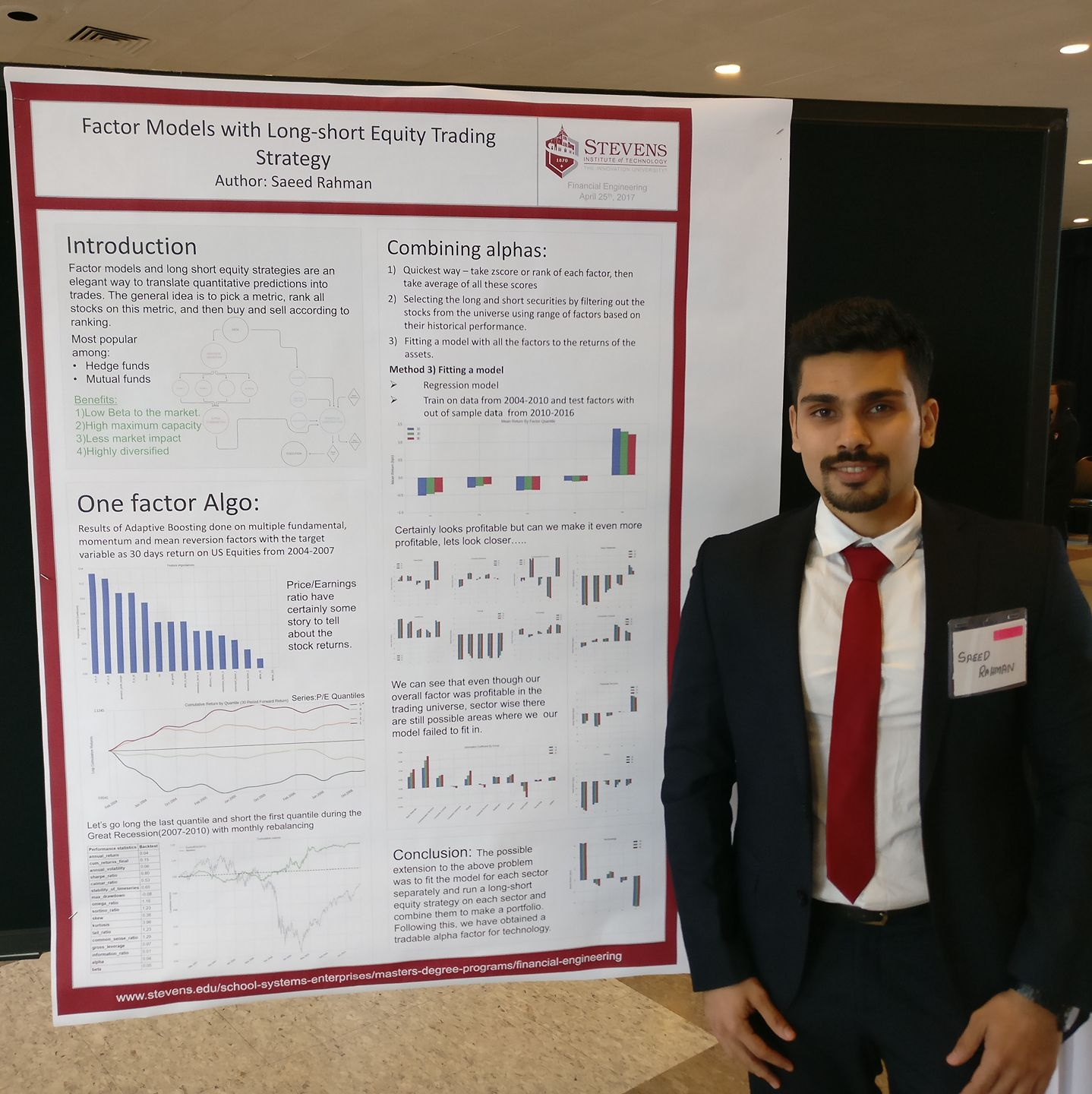
On Quantopian's website, Fawcett shared the transformation story of Saeed Rahman. Saeed was born in a country where the stock market is stigmatized and often equated with gambling. As an undergraduate he trained in time-series analysis and data science, and completed CFA Level I online. Further study at home was impossible, but studying in the US was a wrenching decision — not to mention the financial hurdle without a scholarship (studying finance in America is brutally expensive!). Luckily, during graduate school he discovered Quantopian. For Saeed, the platform was more than a tool; it was a beacon of knowledge and opportunity. It was there that he honed his skills and found inspiration and community.
In one talk, Saeed described how different the community's hands-on posts were from textbooks:
quote
Max Margenot from your team once in his webinars went through OU (Ornstein–Uhlenbeck process - a stochastic differential equation that's used in understanding mean-reverting process), those were things that one normally finds in textbooks or expensive programs like CQF, but here Max was explaining it using Python, and as a student trying to wrap my head around the practical applications of these complex topics, the content your team released was just pure gold. Translation: Textbooks and expensive programs like the CQF only cover the theory of the Ornstein-Uhlenbeck process, but in his webinar Max Margenot showed how to implement such a complex model in Python — for a student trying to grasp the practical application of these complex topics, that content was pure gold.His 2017 talk on exploring reinforcement learning for quant drew wide attention, and the following year he joined the data science team at Jefferies Group.
After his successful transition, Saeed open-sourced his own frameworks: MBATS and Cloud-MBATS, both designed for backtesting and deploying machine learning-based strategies in spot FX and equity markets.
This spirit of sharing, rooted in his own journey and Quantopian's influence, reflects Saeed's belief in democratizing quantitative trading knowledge and tools — another sign that the ideal of democratized finance was catching on.
That was precisely Fawce's vision. "Our mission is to break open the closed world of quant and make it accessible to everyone," he wrote in a blog post on the Quantopian site. "Crowdsourcing alpha was a moonshot, but Quantopian left its mark on the universe and got a large part of the quant finance world to know us and use our tools."
The work of Quantopian and people like Saeed has supported the next generation of quants — especially those from disadvantaged backgrounds who might otherwise never access such resources. Without Quantopian's call, their lives might never have changed.
The end of Quantopian's journey did not end Fawce's quest to democratize finance. After the shutdown, Fawce and Quantopian merged into Robinhood — a brokerage focused on retail investors in stocks and crypto, offering commission-free service online. Robinhood had explicitly written "democratize finance for all" into its mission.
tip
Robinhood is the outlaw hero of medieval English folklore — a chivalrous outlaw who robbed the rich to help the poor. Usually translated as Robin Hood, the name was no accident for the company.Since joining Robinhood, Fawce has kept a low profile. But old Quantopian users were delighted to discover that in late 2023, around Thanksgiving, Quantopian revived community education — free for every enrolled student. If your university is on the university-domain-list, you can sign up for free and access quant courses.
Perhaps this was an answer to the community's calls after Quantopian closed, and to his own deeply held values. In his blog, Fawce wrote that his brother's career in education was an inspiration to him. Our parents put our education first. Much of the philosophy behind Quantopian — devotion to opportunity and education — came from my parents and my brother. Treating education as such a profound value also makes me deeply grateful to hear stories of Quantopian serving people's education.
Closing Thoughts
While writing a course on factor analysis and machine-learning strategies, I stumbled upon Fawce's story. Inspired by the same ideal are not just Quantopian, Fawce, and Saeed, but people scattered around the world — myself included. So I decided to pause and spend a few days digging into Fawce's story to share with you.
Because knowing what you're fighting for will always matter more than the fight itself.
For all quants — and those about to become one.