
The Small-Cap Factor: Banz’s Thesis, Criticism, and Legacy
Rolf W. Banz, a Swiss national, earned his PhD from the University of Chicago in the 1970s and served as faculty there. He later ran an investment boutique in London focused on small-cap stocks, which he sold to Alliance Capital in 1991. In the final stage of his career, he returned to Switzerland, holding senior positions at the asset management subsidiary of a Swiss private bank.
After retiring, he became a blogger. His final post dates back to late 2017.
The Father of the Small-Cap Factor
Banz gained fame for discovering the small-cap factor. In his 1981 PhD thesis, he wrote that based on 40 years of NYSE data, small-cap stocks had a monthly average return 0.4% higher than other stocks. This finding profoundly influenced subsequent markets. In the post-Banz era, overweighting small-cap stocks in fund portfolios became almost a dogma.
In China, research indicates that prior to 2016, the significance of the size factor in China A-shares even surpassed that of developed markets like Europe and the US. This factor underperformed large-cap assets during 2017–2018, but outperformed the CSI 300 starting from 2021.
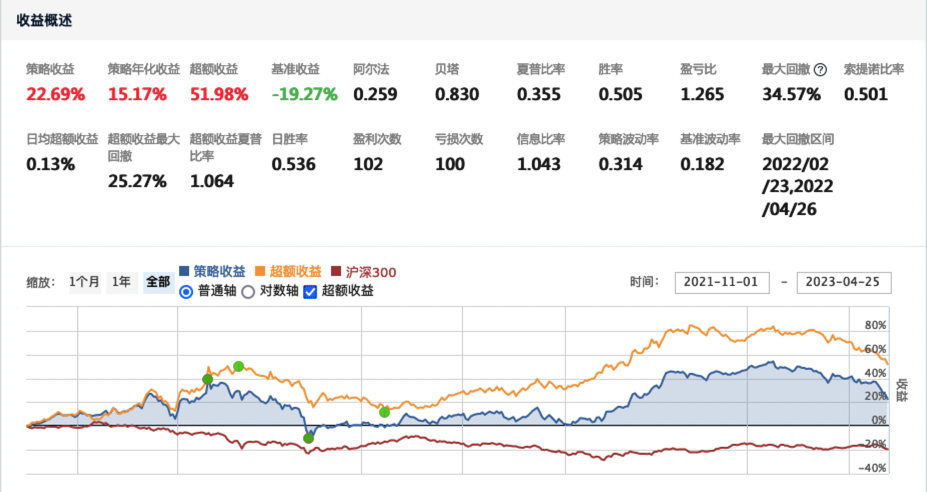
This chart comes from a backtest on the JoinQuant platform. The data shows that over two years, the small-cap strategy achieved a 51.98% excess return, which is quite impressive.
Rolf Banz thus earned the informal title, "Father of the Small-Cap Factor."
This title is not just about the factor itself. If William Sharpe defined the first factor, then the second factor, the small-cap factor, was discovered by Banz. He accomplished the step from one to two, or even from zero to one.
A Thesis Rejected by Titans
Logically, having discovered such a powerful factor, his thesis defense should have been smooth, right? However, when Banz presented his defense, an unexpected event occurred.
The reviewers were all titans: Myron Scholes, Merton Miller, and Eugene Fama, all of whom later won Nobel Prizes. Yet, none of them liked Banz’s findings. Especially Eugene Fama, the proponent of the Efficient Market Hypothesis. Why?
A corollary of the efficient market hypothesis is that there should be only one factor: the market factor. If the market is efficient, there should be no information asymmetry or mispricing. Without mispricing, there are no market anomalies or new factors.
Thus, when Banz presented his results on stage, Merton Miller asked Scholes, "What is his mistake?" The panelists were naturally inclined to deny Banz’s conclusion. Their purpose in reviewing was precisely to prove him wrong!
Banz’s academic achievements did not match those of Scholes, Fama, and others; he was a renowned financial scholar but did not receive major awards. However, if the small-cap factor he proposed is used for investing, it can be highly effective.
Banz’s own investment performance was more successful compared to other financial academics. In contrast, Scholes co-managed the hedge fund Long-Term Capital Management (LTCM), which collapsed in 1998, losing billions of dollars.
Simplicity Is Beauty
Banz’s paper was not complex, only 16 pages. It did not use advanced mathematics, only basic statistical science: GLS and OLS. If computers had been available at the time, this derivation would have appeared exceptionally simple.
quote
if you can’t explain it simply, you don’t understand it well enough. - EinsteinI believe this sufficiently illustrates that in any era, in any circle, there are always low-hanging fruits waiting for the diligent to pluck them.
Banz mentioned in his paper that he could not explain the causes of the small-cap effect.
In reality, this is easy to explain. From a biological perspective, youth, growth potential, and risk always go hand in hand; from an economic perspective, some very large companies have already reached the industry ceiling and achieved high market share. If they also want to double their market cap, they must open a new track, and this track must be as wide as the previous one.
However, for large companies, both innovation and death are difficult.
If scholars before Banz had been able to look at the market beyond the confines of econometrics, while possessing solid statistical and mathematical foundations, they could have discovered this factor much earlier.
Because the biggest secret of building an atomic bomb is that an atomic bomb is buildable.
The Post-Banz Era of Banz
Although the statistical knowledge used in Banz’s small-cap factor paper was very basic, the word solid is actually harder to achieve than we imagine. For such a paper, despite being flawless in form, it still faced substantial质疑 (questioning).
In 1999, Tyler Shumway and Vincent Warther pointed out that Banz’s research method had significant errors: he forgot to subtract the negative effect of delisted stocks. Their article, titled The Delisting Bias in CRSP's Nasdaq Data and Its Implications for the Size Effect, was published.
In 2011, Gary A. Miller and Scott A. MacKillop argued that small caps do not outperform large caps. They used the S&P 500 Index to represent large caps and the CRSP9-10 Index to represent small caps, both traceable to 1926. According to their research, the returns of CRSP 9-10 and DFA funds from 1980 to 2000 were lower than the S&P 500 Index, although the gap was not large.
note
Actually, this conclusion is easily misleading. It actually proves the effectiveness of the small-cap factor. The performance of the S&P 500 Index far exceeds that of most fund managers. Additionally, according to Miller & MacKillop, the small-cap factor merely has a lower Sharpe ratio than large caps -- which is a fact Banz had already pointed out in his paper.