
Political Alpha: Quantifying Congressional Trading Patterns
In July 2022, the U.S. Congress officially passed the CHIPS and Science Act. Under this legislation, the U.S. allocated $39 billion in direct incentives for semiconductor manufacturing, alongside over $52 billion in related incentive funds, to attract companies to build and expand factories in the U.S. Following the act’s passage, semiconductor stocks surged across the board.
Prior to the act’s passage, a so-called “stock market guru” placed a precise bet, investing $5 million in NVIDIA. Within a month, this position potentially yielded over $1 million in profit (a 20% return). This disclosure reignited public interest in the “Congressional Stock Market Guru.”
This individual is Paul Pelosi, husband of Nancy Pelosi. At the time, Nancy Pelosi served as Speaker of the House, wielding significant influence over the passage of the legislation.
01
Between 2020 and 2022, Paul Pelosi executed precise trades in tech stocks ahead of major policy shifts:
- In June 2021, Paul Pelosi purchased 400 call options on Alphabet (Google’s parent company). Subsequently, Google’s stock rose 17% due to developments in antitrust litigation, allowing Paul Pelosi to secure approximately $5 million in profits.
- In June 2022, after the CHIPS and Science Act passed the Senate but before the final House vote, he purchased $5 million worth of NVIDIA stock. One month later, after the act’s official passage, NVIDIA’s stock rose by approximately 20%, generating roughly $1 million in profit.
- In July 2022, following the official passage of the CHIPS Act, he further increased his NVIDIA holdings by $1 million to $5 million.
According to data from UnusualWhales, the Pelosi family’s portfolio achieved an annualized return of 65% between 2020 and 2022, far exceeding the S&P 500’s 26% return during the same period.
Pelosi is not an isolated case among Congressional “gurus.” According to public disclosures, Florida Representative Debbie Wasserman Schultz purchased $15,000 to $50,000 worth of Microsoft stock in December 2020, while her House Military Committee was discussing a major procurement plan involving Microsoft’s government cloud contracts. Three months later, Microsoft’s stock rose by 22%.
A more controversial example involves New Jersey Representative Josh Gottheimer. In July 2021, he purchased $100,000 to $250,000 worth of Pfizer stock. Just two weeks later, the FDA announced full approval of Pfizer’s COVID-19 vaccine, causing the stock price to surge. At the time, Gottheimer was a member of the House Energy and Commerce Committee, which holds significant influence over healthcare policy.
02
Naturally, the trades of Congressional “gurus” are not secret. Under the STOCK Act passed in 2012, members of Congress are required to report their trades within 45 days. If you visit unusualwhales.com, you can track all of Nancy Pelosi’s trades.
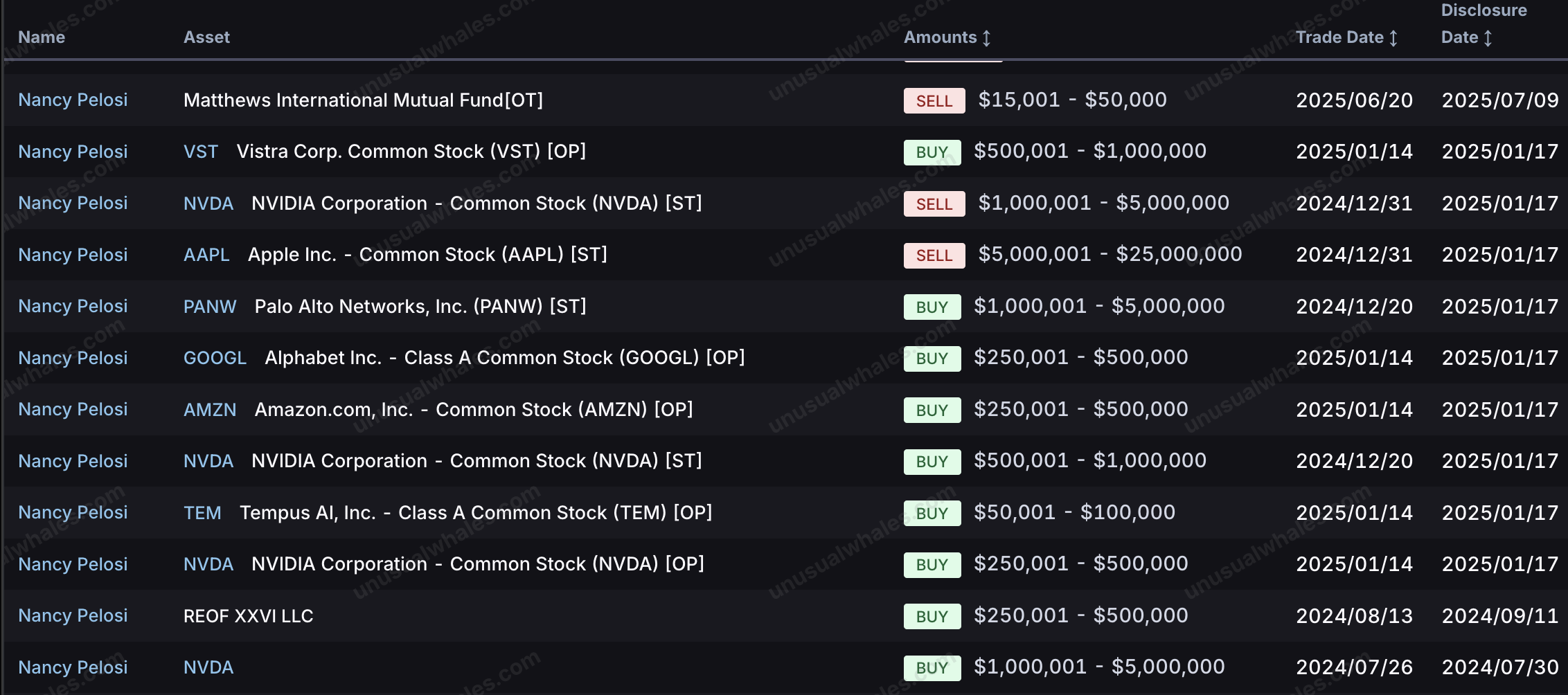
Below are the trade records for Trump, who famously claimed, “Nobody knows stocks better than me”:
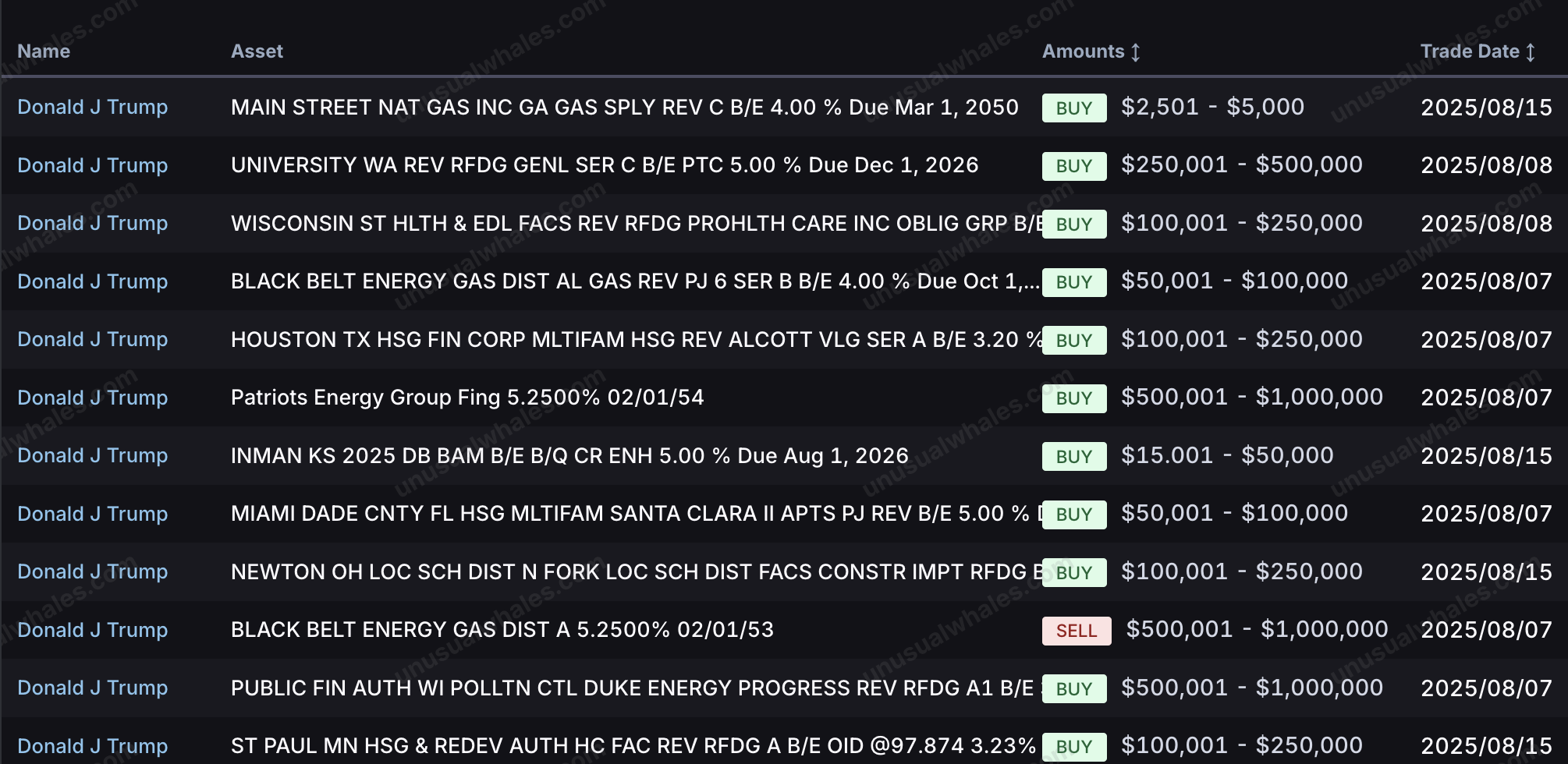
This is not just one website; in fact, tracking and analyzing political figures’ trades has become an industry.
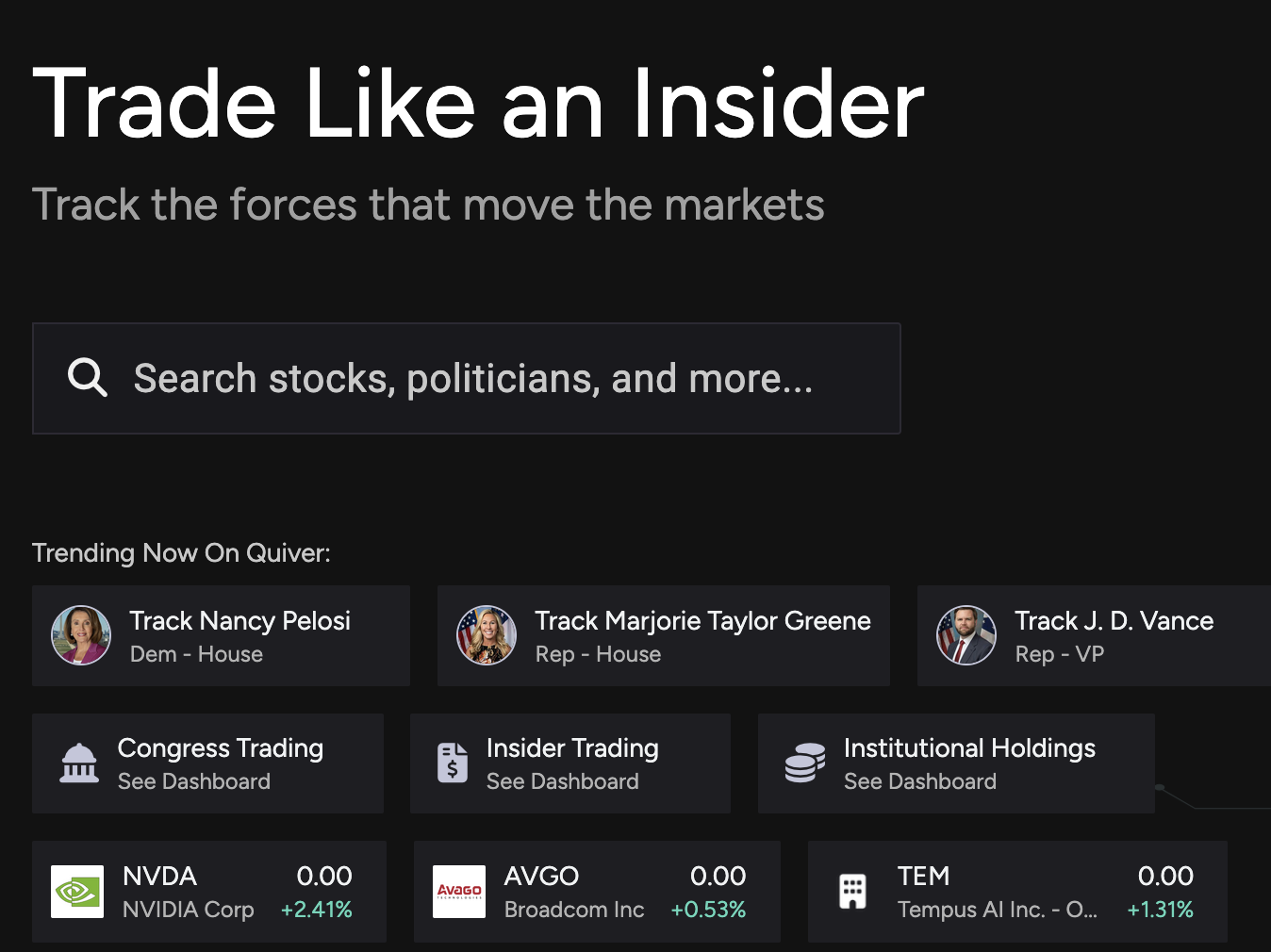
Here is the tracking provided by QuiverQuant:
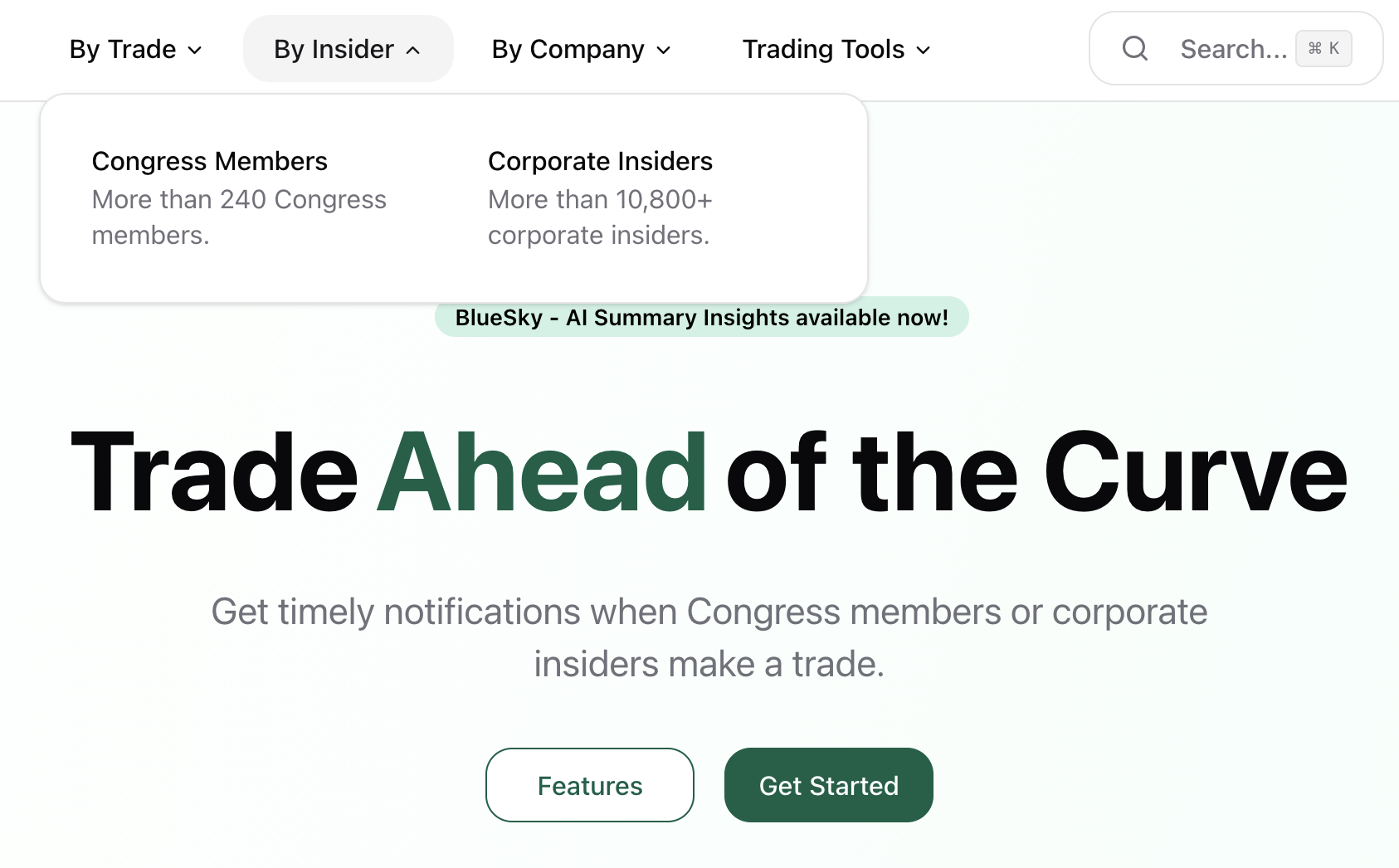
TradeInsight performs similar functions, offering push notifications as well:
Among all these platforms, capitoltrades.com appears to offer the most professional service:
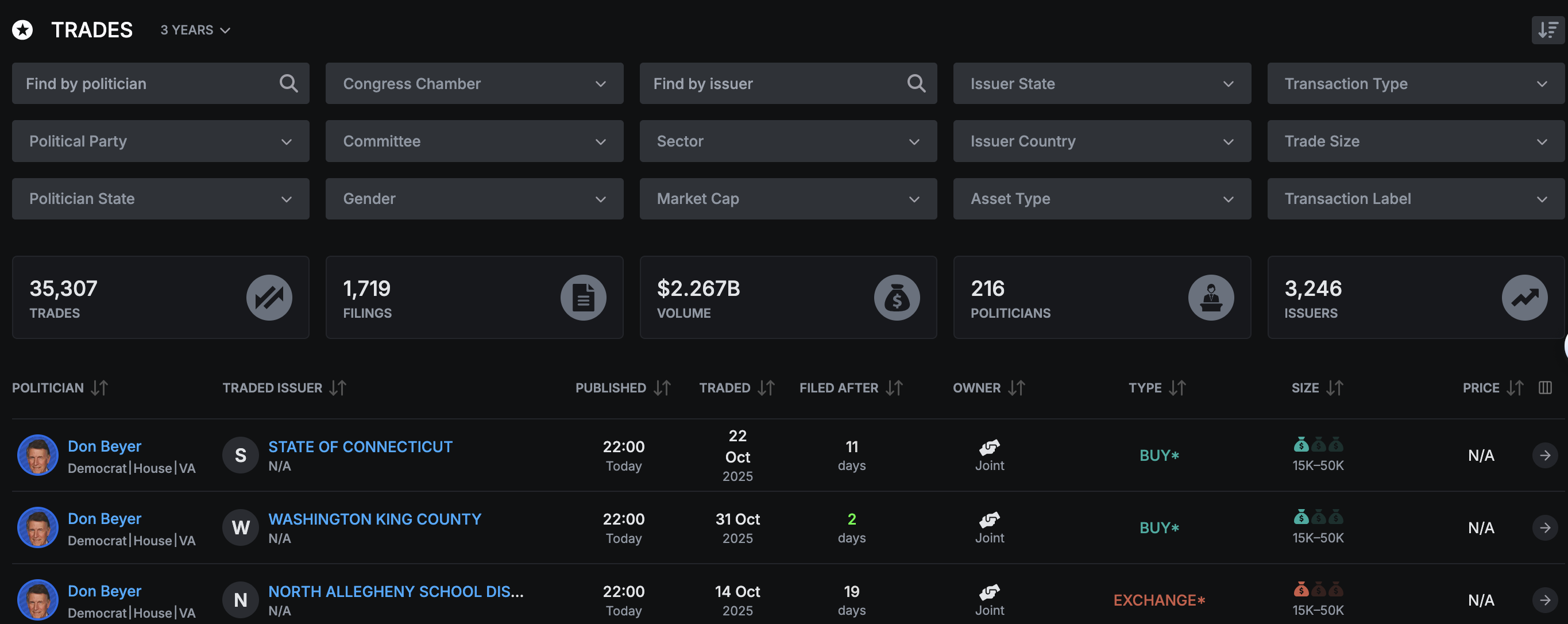
It has already begun categorized analysis.
03
Beyond these specialized websites, there are Twitter accounts dedicated to tracking these political figures’ trades. This data has become what the investment industry calls “alternative data,” known as Political Alpha.
So, where does Political Alpha actually come from? Is it truly insider trading? And what are the risks if we track these trades?
Clearly, Political Alpha exists, as evidenced prominently in Nancy Pelosi’s case.
Here is the “Pelosi Index”:
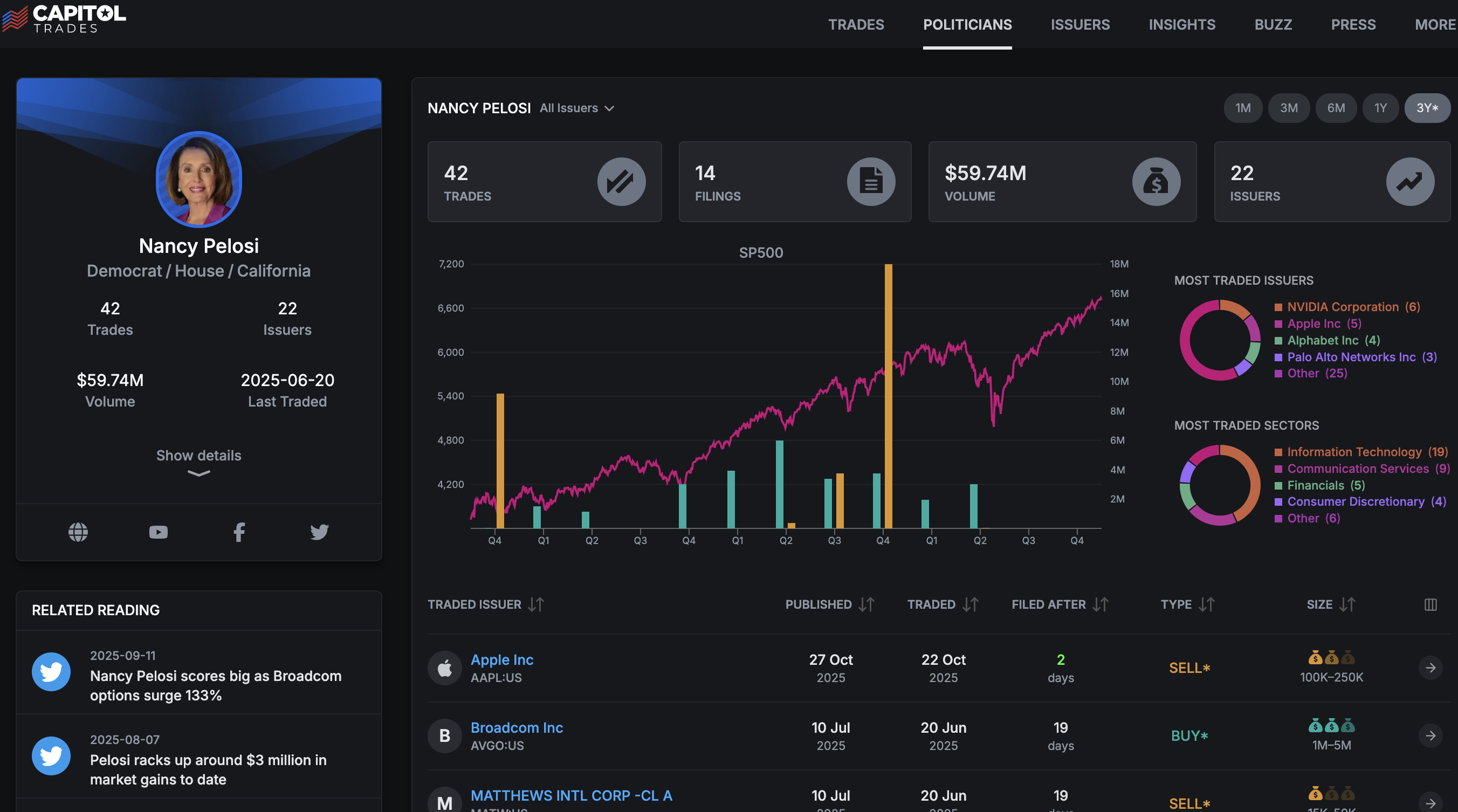
As a Democratic Representative, her portfolio is heavily weighted toward tech stocks, which is not surprising (note that she has been reducing her Apple holdings since late last year). However, her trading records suggest precise timing. For instance, several of her buy points coincided with S&P 500 lows, and after her largest sell-off, the S&P 500 nearly stalled before dropping significantly. By Jesse’s Alpha definition, Pelosi’s operations indeed exhibit alpha.
However, it may be too simplistic to label all these trades as insider trading. Looking at the Pelosi family’s trades around the passage of the CHIPS Act in June 2022, even if they leveraged this information, it was largely public knowledge. Defenders argue that while legislators possess an informational advantage, this does not constitute illegal insider trading. They access policy trends and industry insights rather than specific corporate confidential information.
Federal Reserve interest rate policy is a key indicator influencing the S&P 500’s阶段性 (phased) trends. Given the public sparring between Powell and Trump, if even Trump cannot influence the Fed’s interest rate policy, Pelosi’s influence would be even more limited. In this sense, we might set aside “conspiracy theories” and seriously examine the positive implications of Political Alpha.
For quants, the key takeaway is that this phenomenon has spawned an emerging field of data analysis. Beyond simply following the trades, we can conduct deeper analysis.
The first step is obtaining timely, comprehensive, and primary trade data. This is the goal of this article. We are sharing this “open secret” because previously, users could only passively track these websites. Now, someone has open-sourced their analytical methods. Just last week, it was released on GitHub1.
04
This tool is named congressional-filings-explorer.
Technically, it is a Python-based tool that relies on poppler-utils and pdf2image (both used for PDF processing) to automatically handle House financial disclosure PDFs, and then uses OpenAI to analyze these files, leveraging the OpenAI Vision API. If access to OpenAI is restricted in your region, you can substitute models like DeepSeek OCR, though you may need to modify the interface.
Here is a partial output after running the tool:
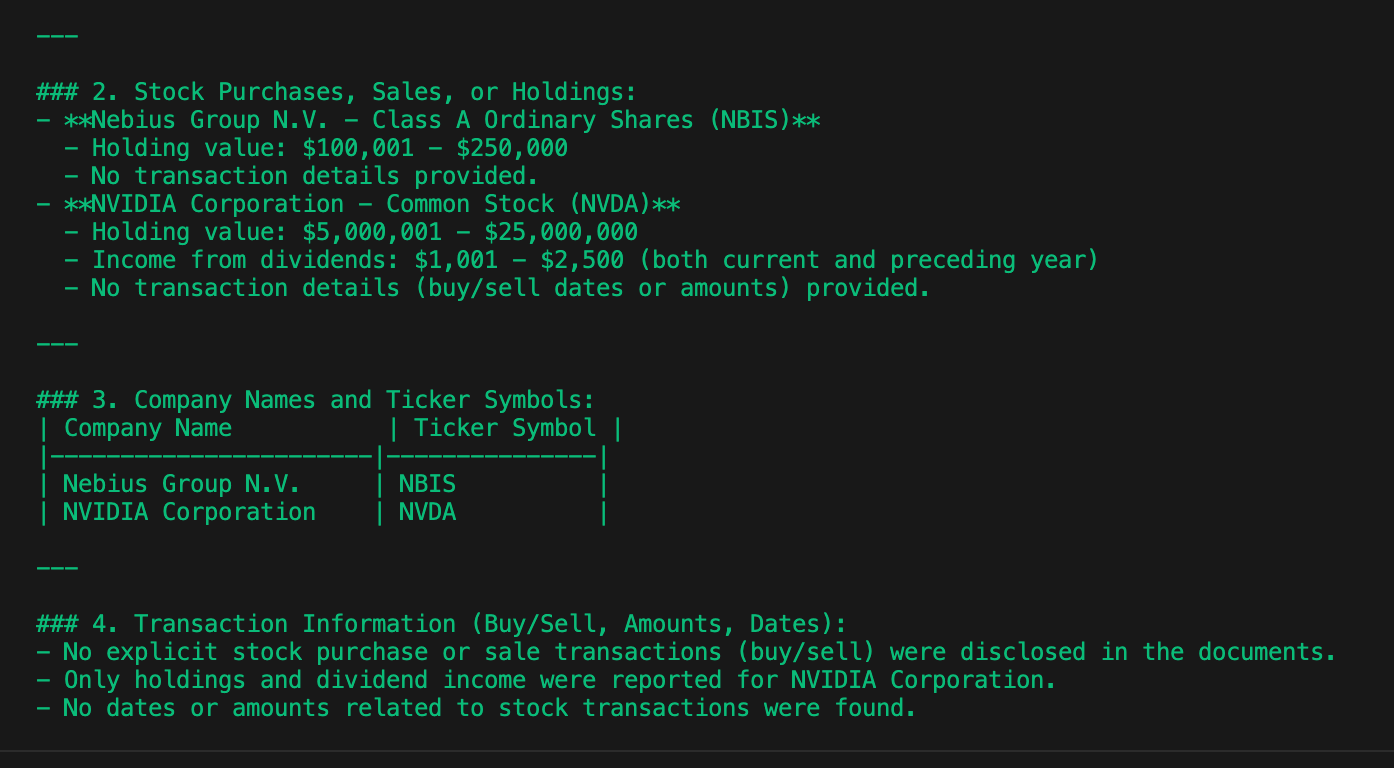
With this tool, you can obtain primary data similar to the websites mentioned above and potentially conduct more in-depth analysis.
To analyze Political Alpha, you first need a list of political figures. This data can also be found on GitHub. There is a repository with 2.3k stars on GitHub: congress-legislators2, which provides information on U.S. Congress members dating back to 1786.