
Stat Arb’s 75-Page Quant Roadmap: The Ultimate Self-Study Guide
The header image features Simmons Hall at MIT. Copyright: wiki/public domain.
This building belongs to Simmons University, an affiliate of MIT, donated by tailor John Simmons. Simmons Hall is widely regarded as one of the most beautiful buildings in Boston. Simmons University is female-friendly; its MBA program was the world’s first MBA designed specifically for women. To date, its undergraduate education remains predominantly female, while graduate programs are co-ed.
This is a self-study quant roadmap curated by Stat Arb. His blog boasts over 9,000 paying subscribers. The roadmap is available as a 74-page PDF and is remarkably comprehensive.
"Stat Arb" derives from Statistical Arbitrage. His true identity is an industry insider currently taking it easy, but that’s secondary; what matters is the quality of the resources he provides.
I obtained the 2024–2025 edition, released just two weeks ago. He has published similar roadmaps annually, consistently updating them to reflect market changes. The content is so thorough that readers with different career objectives can all benefit.

My favorite section is the data resources. A significant portion is free, particularly crypto projects and datasets from Kaggle, totaling dozens of gigabytes. He also offers some paid data dumps, though access may require passwords available on X (formerly Twitter).
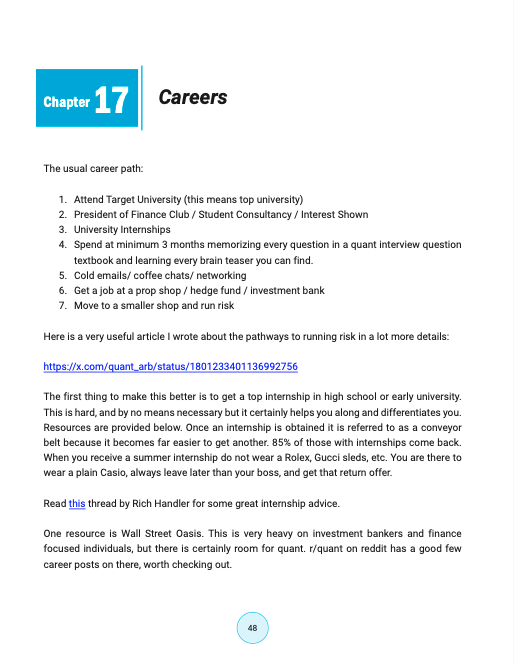
Job seekers may prefer Chapter 17, which covers career planning and interview preparation. We are also gradually introducing information about universities and investment firms, in case you need to apply to them in the future.
Chapter Contents
Chap 01
Introduces textbooks on machine learning and algorithmic trading, including foundational and advanced texts such as Quantitative Trading (2nd edition), Algorithmic Trading, and Machine Trading. It also evaluates various models and methodologies.
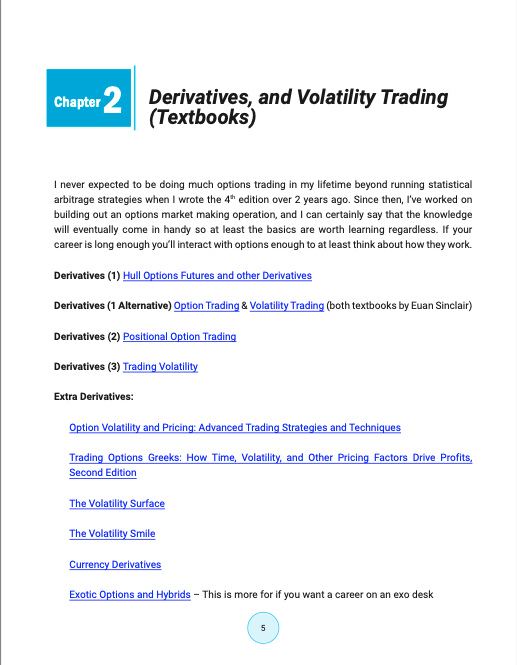
Chap 02
Covers textbooks on derivatives and volatility trading, recommending titles like Hull: Options, Futures, and Other Derivatives and Option Trading & Volatility Trading. It also introduces related knowledge and resources, such as dynamic hedging and stochastic volatility.
Chap 03
YouTube Resources: Recommends videos from creators like Ben Felix, Patrick Boyle, and Leonardo Valencia, covering topics such as volatility, algorithmic trading, and signal processing. Courses: Highlights Robert Shiller’s Financial Markets on Coursera, Andrew Ng’s machine learning and deep learning courses, and quant-specific courses by RobotJames, HangukQuant, and Euan Sinclair.
Chap 04
Recommends podcast resources such as Tick Talk, Flirting with Models, and Mutiny Fund, emphasizing podcasts as vital learning tools that provide substantial practical information.
Chap 05
Trading Platforms and Brokerages: Introduces platforms for equities and other asset classes (e.g., IBKR, TD Ameritrade) and digital asset exchanges (e.g., Binance, OKX, Bybit).
Chap 06
Neural Networks / Machine Learning / Hype: Argues that neural networks are not central to quant trading and advises against deep research in this area. Instead, it recommends learning regression, non-parametric methods, decision trees, and GAMs.
Chap 07
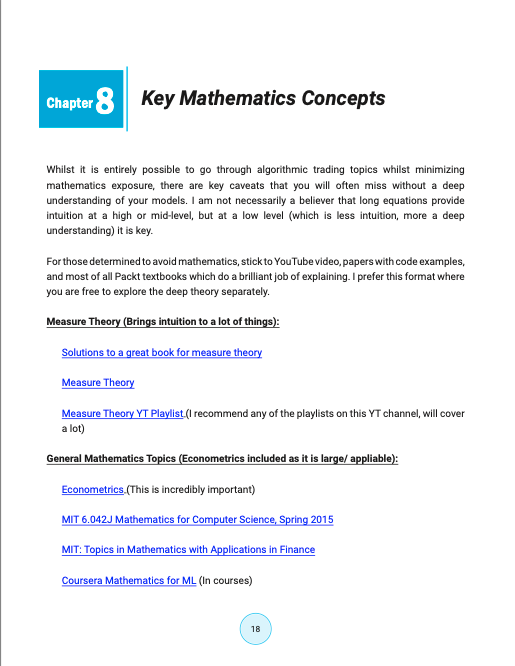
Key Mathematical Concepts: Emphasizes the importance of mathematics in algorithmic trading, recommending resources on Measure Theory, Econometrics, Stochastic Calculus, and Probability Theory.
Chap 08
Optimization (Deterministic and Stochastic): Discusses the application of optimization in quant trading, such as estimating implied volatility, distributions, automated alpha discovery, and portfolio optimization.
Chap 09
High-Frequency Trading (HFT) and Market Making: Recommends textbooks and resources on HFT and market making, such as High-Frequency Trading: A Practical Guide to Algorithmic Strategies and Trading Systems (2nd edition) and Inside The Black Box.
Chap 10
Other Volatility/Derivatives Resources: Recommends resources on volatility and derivatives, including content from the Moontower Quant and Vol community and the Options Starter Pack.
Chap 11
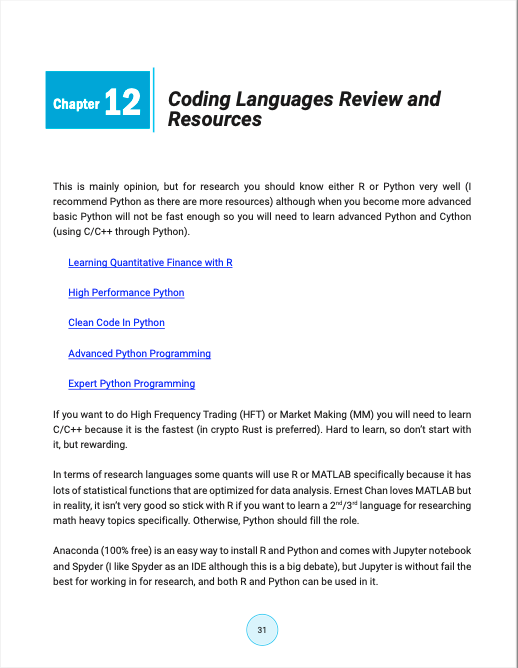
Programming Languages: Recommends Python for quant research. For HFT or market making, it suggests learning C/C++ (or Rust in the crypto sector).
Chap 12
Projects: Introduces deep learning-related projects but warns against over-complication, advising a focus on regression and practical methods.
Chap 13
Data: Details data sources, including paid data dumps, free exchange data, and competition datasets, while recommending specific data providers.
Chap 14
GitHub Repositories: Recommends GitHub repositories related to algorithmic trading, such as stefan-jansen/machine-learning-for-trading and barter-rs/barter-rs.
Chap 15
Light Reading: Recommends finance-related books such as Liar’s Poker, Flash Boys, and Irrational Exuberance.
Chap 16
Careers: Outlines typical career paths in quant trading, including attending top universities, completing internships, and preparing for interviews, while recommending relevant resources.
Chap 17
Arbitrage Guide: Focuses on arbitrage in the digital asset sector, introducing types such as funding rate arbitrage, triangular arbitrage, and spot arbitrage, along with websites and resources for scanning arbitrage opportunities.
Chap 18
Market Making Guide: Covers key aspects of market making, including edge (accurately predicting mid-price and reacting to events with low latency), spreads (adjusting spreads based on asset volume), and risk (avoiding complex inventory balancing equations, as correlations in models may not hold).
Chap 19
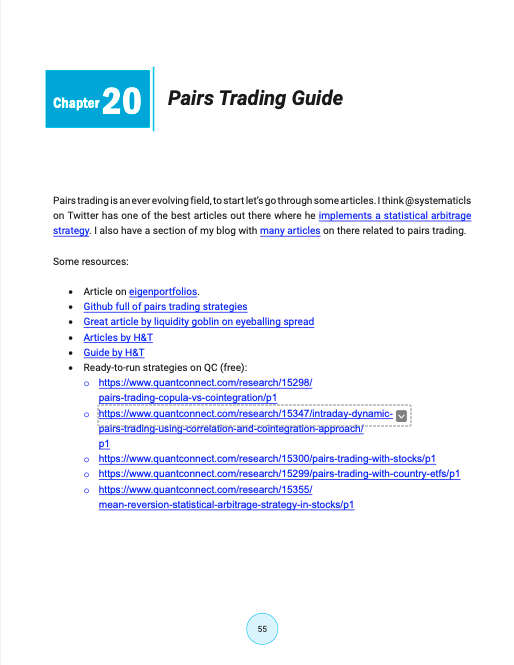
Pair Trading Guide: Introduces resources on pair trading, such as articles by @systematicls, related posts on the author’s blog, and pair trading strategies on GitHub.
Chap 20
Seasonality Guide: Provides links to the author’s blog posts on seasonality strategies, as well as a paper and PnL curve co-authored with HangukQuant on seasonality strategies.
Chap 21
Momentum Guide: Provides links to resources on momentum strategies on the author’s blog.
Chap 22
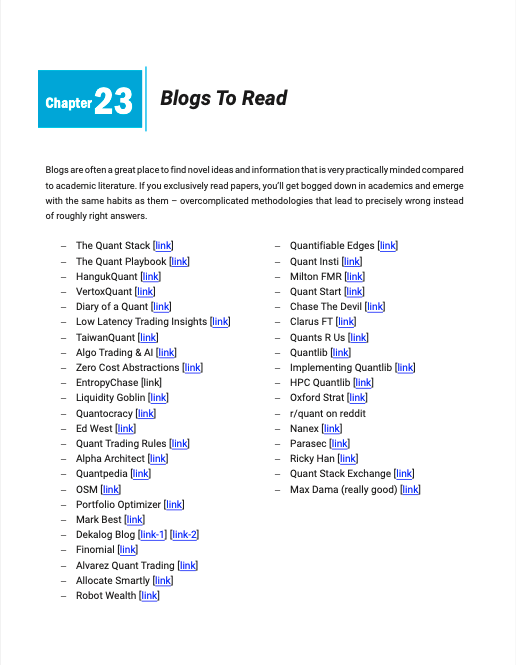
Blog Reading: Recommends blogs related to quant trading, such as The Quant Stack, The Quant Playbook, and HangukQuant.
Chap 23
Twitter Accounts to Follow: Lists notable Twitter accounts, such as Vertox_DF, Ninjaquant_, and BeatzxBT.
Chap 24
How to Study This Material: Emphasizes the importance of learning methods, suggesting readers filter content, implement and discuss what they learn, avoid building unnecessary tools or vanity projects, and focus on learning through practice.
Chap 25
Other Roadmaps: Recommends other quant trading resource lists, such as Vertox’s list, Moontower’s list (especially for options), Moontower’s blog and online writers, the Options Starter Pack, QM’s textbooks, and QuantGuide.