
Top 7 Journals Every Quant Finance Professional Should Read
We have curated seven top-tier academic journals that every quantitative finance professional should follow. From the foundational Efficient Market Hypothesis to the latest research on cryptocurrencies, these publications represent the pinnacle of financial academia.
Journal of Finance
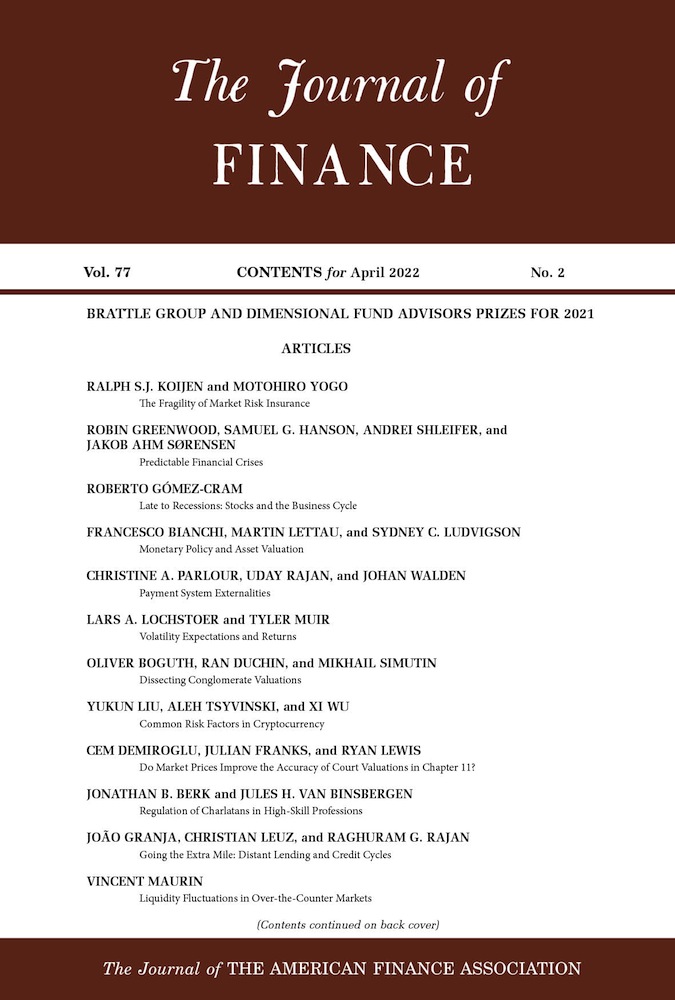 Undisputedly the No. 1 journal in the field.
Launched in 1946, this premier academic journal is published by the American Finance Association (AFA).
It attracts submissions from top scholars worldwide and serves as a critical benchmark for academic achievement and career progression.
Many early works by Nobel Laureates in Economics were published here, laying the foundation for modern finance. These include Modern Portfolio Theory (Markowitz), the Capital Asset Pricing Model (William Sharpe), the MM Theorem (Merton H. Miller), and the Efficient Market Hypothesis (Eugene Fama).
Other seminal papers include Richard Thaler’s 2017 work, "Anomalies: The Winner’s Curse," a pioneer in behavioral finance that demonstrates how behavioral biases of market participants affect asset prices.
In 1968, Michael Jensen’s "The Performance of Mutual Funds in the Period 1945-1964" first explicitly defined the concept of Alpha. This idea has endured as a guiding beacon, becoming a core objective pursued by both researchers and practitioners in quantitative finance.
Journal of Financial Economics
In 1981, Rolf Banz’s article "The relationship between return and market value of common stocks" (introducing the size factor) was published in this journal.
In 2015, Eugene Fama chose this journal to publish his Five-Factor Model.
Journal of Empirical Finance
Launched in 1994.
This journal emphasizes empirical research, aiming to bridge the gap between financial theory and real-world data. It has become a vital platform for empirical financial studies. With a rejection rate of 85%, 40% of rejected manuscripts receive no feedback on the reasons for rejection.
Review of Financial Studies
Published by Oxford University Press, this is a peer-reviewed academic journal.
Its impact factor was 5.814 in 2020, ranking 5th out of 110 journals in the Business and Finance categories.
The paper "Market Liquidity and Funding Liquidity" was first published here. On Google Scholar, this paper has been cited over 6,500 times.
Journal of Portfolio Management
Focused on the practice and theory of portfolio management, this journal covers various aspects including asset allocation, risk management, quantitative strategies, market analysis, portfolio optimization, smart beta strategies, liquidity management, and global macro strategies.
Quant professionals in asset management should read every issue without missing a beat.
JFQA
JFQA stands for the Journal of Financial and Quantitative Analysis.
First published in 1966, it appears six times a year, effectively functioning as a bimonthly journal.
It covers a wide range of topics, including asset pricing, corporate finance, financial markets, market microstructure, empirical finance, and financial econometrics.
The Journal of Trading
This journal focused on trading strategies, market dynamics, and trading technologies, but it has since ceased publication.
A similar publication is The Traders' Magazine. While not a top-tier academic journal, it stands out for its practical approach to trading technology, offering strong practical value over theoretical depth, and maintains a dedicated subscriber base.