
How the Dutch East India Company Built the First Stock Exchange
Along the Huangpu River, near the Waibaidu Bridge, stands a British Neoclassical building with over a century of history. Once the famous Puxing Hotel, it is now known as the site of the first stock exchange in New China and has become a popular tourist attraction as the China Securities Museum.
{: .img-center-75 }
At the end of 1990, the Shanghai Stock Exchange (SSE) was officially established. It was the first stock exchange in mainland China since the founding of the People's Republic. At that time, only eight stocks were listed, with a market capitalization of 1.234 billion RMB, making it the "smallest" securities market globally. Today, the number of China A-share listed companies has exceeded 5,000[^milestone1], making it the second-largest spot equity market after the United States and making significant contributions to China's economy.
Following the SSE, the Shenzhen Stock Exchange (SZSE) was established, and the Beijing Stock Exchange (BSE) was launched in 2021. Securities trading has become commonplace for ordinary citizens. However, at the time, establishing a stock exchange was highly controversial. Historically, the emergence of stock exchanges was considered a major milestone in the development of capitalism. Today, we explore this milestone.
The first cornerstone of this milestone was laid in the Netherlands around 1602. Those familiar with Ming Dynasty history may recognize this period as corresponding to roughly the 27th year of the Wanli Emperor's reign.
Spices
Everything begins with spices. In medieval Europe, spices were extremely expensive. By "spices," we do not mean modern perfumes or flavorings, but rather culinary spices such as pepper, cloves, cinnamon, nutmeg, and ginger.
 {: .img-center-75 }
European nobility highly valued food prepared with spices. In modern terms, meat without spices was considered "soulless." This fervent demand turned spices into luxury goods, even equating them with gold at times. Pepper, in particular, was known as "black gold."
Due to climate constraints, most spices could not be grown in Europe. However, dried spices were durable and suitable for long-distance transport. As humanity entered the Age of Discovery, intercontinental spice trade began. This transport was prone to shipwrecks and piracy, carrying extremely high risks. The Dutch were the first to realize that individual merchants lacked the financial capacity to support fleets for such voyages. Thus, in 1602, 17 merchants formed the world's first joint-stock company.
The Dutch East India Company
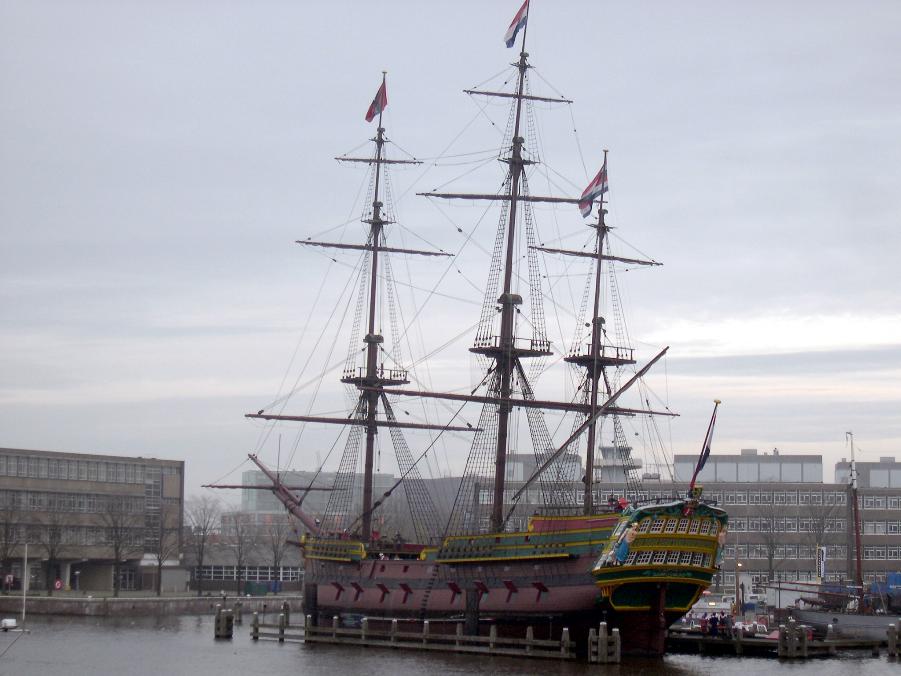
This company was the Dutch East India Company (VOC). Historically, there were at least two famous East India Companies. The other was the British East India Company, established in 1600, which held a monopoly on Indian trade for two centuries. Generally, when we refer to "the East India Company," we mean the British one. However, in the remainder of this article, "East India Company" refers to the Dutch East India Company.
 {: .img-center-75}
After its establishment, the Dutch East India Company publicly issued shares. In the capital alone, 1,000 people purchased shares, raising an initial capital of 6.5 million Dutch guilders. In contrast, the initial capital of the British East India Company at the same time was only 72,000 pounds, merely one-tenth of the Dutch company's capital.
This substantial initial capital gave the Dutch East India Company a competitive advantage. Consequently, it rose rapidly, seizing the maritime trade monopoly previously held by Spain and Portugal. The company operated very well in its first 50 years, providing annual dividends exceeding 16%. It owned 150 merchant ships and controlled 40 warships, with over 20,000 sailors, 50,000 civilians, and over 10,000 soldiers[^soldiers] serving it.
This scale is astonishing. Consider that today, even the largest global IT giants have no more than 400,000 employees.
Liquidity Issues and Solutions
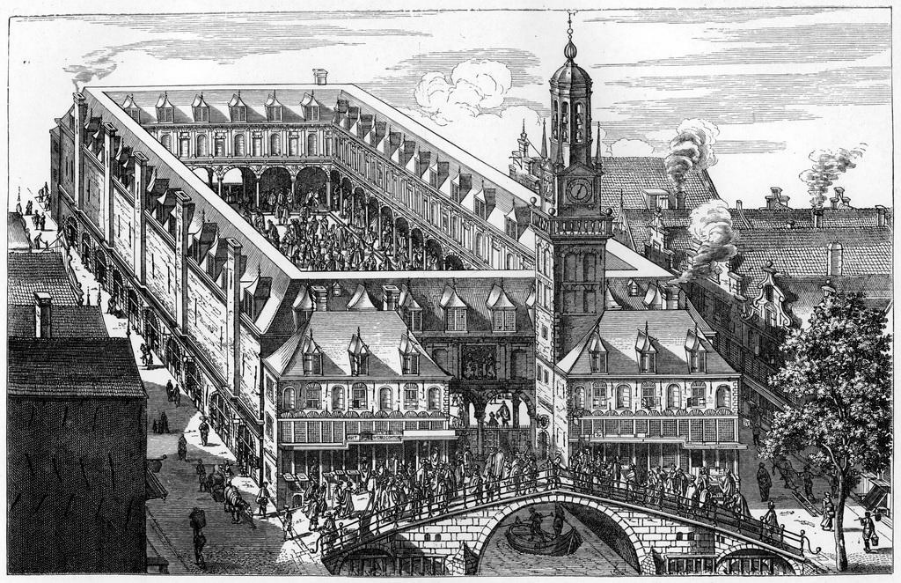
Initially, VOC shares were issued through trading. The Amsterdam Stock Exchange was the world's first stock exchange.
Early laws stipulated that VOC shares could be redeemed by the company for their principal at the holder's discretion. This meant the company had to maintain a reserve fund to pay for potential buybacks, which reduced capital efficiency and carried the risk of a bank run.
In 1609, the board of directors decided to stop returning the principal. If shareholders needed urgent cash or were dissatisfied with the company's performance, how could they exit and cash out? From that point on, the exchange added secondary market trading functions. Thus, the Amsterdam Exchange became the first fully modern stock exchange.
 {: .img-center-75 }
Trading was active at this exchange. The VOC's average annual turnover rate was around 7%. By 1607, only two-thirds of the initial owners still held their shares. Based on this strong liquidity and the company's high annual dividends, VOC shares became high-quality collateral. Therefore, during the company's existence, it did not raise funds through new equity issuances. If financing was needed, the company issued 12-month bonds to meet its capital requirements.
The Essence of Financial Instruments
From their inception, financial instruments have been intertwined with greed, risk, and博弈 (game theory). Financial practitioners are sometimes criticized as cunning merchants, shameless speculators, and mad gamblers. However, if we abandon emotional perspectives and clear away the fog of history, we can easily discover that financial instruments have played a huge role in organizing production capital and smoothing market cycles.
In the example of fertilizer options in Episode 1, we saw that intermediaries were pure rent-seekers. Yet, the intermediaries' selfishness and greed smoothed price fluctuations for farmers and fertilizer producers, enabling production to proceed in a planned and sustainable manner, thereby continuously creating social wealth.
This is the power and characteristic of the market: everyone aims to achieve their own interests, but ultimately drives social innovation and progress.
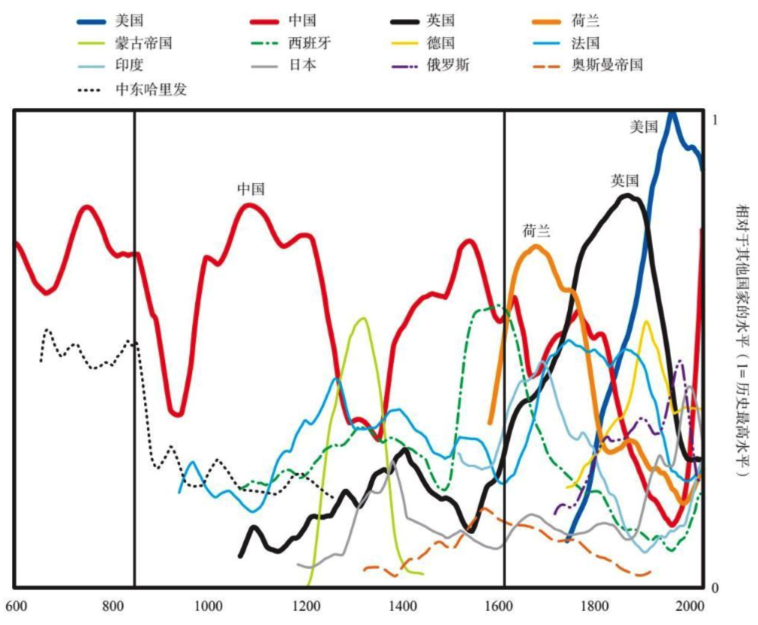
In the case of the Dutch East India Company, shares played the role of raising initial capital; while the securities trading market, by providing liquidity, allowed the company to use its raised funds continuously, stably, and efficiently (the company no longer needed to hold cash to应对 stock redemptions). Driven by capital, Dutch maritime trade and national power developed increasingly, earning the title "Maritime Coachman" and becoming the most powerful and wealthy nation in Europe for centuries.
 {: .img-center-75}
Moreover, company growth and financing is a step-by-step process. Angel investors are the first to discover commercial萌芽 (germs) and invest, obtaining capital appreciation in subsequent Series A rounds; the capital appreciation of Series A investors is realized through Series B financing; and so on, until the company finally succeeds in its IPO, with equity entering secondary market trading.
Not every company can successfully go public. However, the enormous wealth effect of those that do, like magnets and vortices, attracts the last-round investors in the primary market, pushing back step-by-step to the angel round, thereby driving massive capital to promote innovation and creation.
This was precisely the original intention behind the state's establishment of the SSE. We have already witnessed the enormous achievements of capital markets and the majestic momentum they bring. With the implementation of the comprehensive registration-based system this year, this momentum will be endless and even stronger.
If you enjoy this book, you can purchase it by clicking here.
 {: .img-center-50}
[^milestone1]: On November 22, 2022, with the listing of Dingtai Hi-Tech and Matrix Shares on the SZSE, China's A-shares exceeded 5,000 listed companies. According to the Shanghai Securities News, it took 10 years for A-shares to grow from inception to 1,000 companies, another 10 years to reach 2,000, 6 years to reach 3,000, less than 4 years to reach 4,000, and 2 years and 2 months to reach 5,000.
[^soldiers]: Despite the era's context, some methods used by the East India Company in conducting trade remain controversial to this day. These methods included brutal military actions, massacres of local populations, and assassinations of competitors. In a sense, the East India Company achieved its monopoly through "fire and sword."